Wednesday, September 21, 2022

Lowell Wakefield and the Birth of the Alaska King Crab Fishery

The Alaskan king crab fishery began in the late 1940s and rocketed into legend by the 1960s, fueled by a huge swarm of crab, new fishing and processing technologies, a boisterous fleet of enthusiastic fishermen and processors, and the rising affluence of American consumers.

Those circumstances perhaps made the fishery inevitable, but without Lowell Wakefield, the fishery would likely not have happened as soon, or as explosively as it did, and the history of Alaska would be different. While there were other people present at the advent of the king crab era, Wakefield’s vision made the king crab fishery happen the way it did.

Born in 1909 in Anacortes, Washington, Wakefield was the son of an Alaskan salmon and herring cannery operator with plants at Seldovia and Raspberry Strait, on Kodiak Island. He attended the University of Washington and Columbia, but in his early 20s, instead of following his father to Alaska or going into some other business, he became, like thousands of other young Americans scarred by the Depression and the apparent failure of capitalism, a Communist Party organizer and journalist.

In the early1930s he founded and edited the Voice of Action, the unofficial newspaper of the Northwest Communist Party, based in Seattle, and then wrote for the Daily Worker, the Party’s national newspaper. In 1934 he ran for the Washington State Legislature on the Communist Party ticket.

But then, after the Japanese bombed Pearl Harbor in 1941, Wakefield joined the Navy. When he came back from the war in 1945, he abandoned the Communist cause and headed for his father’s cannery in Raspberry Strait. He landed there just as the big bang of the Alaskan king crab fishery ignited.

Japanese and Russian fishermen had been catching king crab in the Bering Sea since the 1920s with tangle gear, fences of web laid on the sea floor which the crab walked into. Some of this crab, canned at sea, was marketed in the U.S through the 1930s.

Alaskan processors were aware of this fishery and persuaded a few investors, and eventually the U.S. Department of the Interior, to send a catcher vessel, the Dorothy, and a processing ship, the Tondeleyo, to survey for king crab along Alaska’s coast and put into cans whatever crabs they might find. The ships worked for four summers, 1938 to 1941, carrying a crew of scientists, economists and fishermen. Using trawl nets, they found significant concentrations of king crab in the eastern Bering Sea and around Kodiak Island.

Some of the trawls were conducted in Raspberry Strait, right in front of the Wakefield cannery. The expedition left some of its gear on the beach and during the war Lee Wakefield used it to catch crab, which he canned in his plant. But without knowing much about the crab’s habits, or how best to process it, the American king crab fishery, including the effort in Raspberry Strait, went nowhere.

In 1946, with the crab surveys in mind, Lowell Wakefield formed a new company, Deep Sea Trawlers Inc., with a plan to catch and process king crab in the Bering Sea. With capital raised by selling company stock to friends and with a loan from the Federal Reconstruction Finance Corporation, Wakefield built the Deep Sea, a 140 foot steel trawler. Designed for the heavy weather of the Bering Sea, the Deep Sea carried everything necessary to catch, process, and freeze Alaskan king crab. Frozen food was a new thing in the American marketplace, but Wakefield believed that high quality frozen crab meat would taste better than canned and appeal to consumers.

At first the Deep Sea used trawl nets to catch the crab, just as the Tondelayo had done before the war, but the nets mangled the crab as they were towed on the bottom and crushed them under their own weight as the bag was hoisted to the surface. This didn’t matter if the crab meat was canned, but it was not ideal for Wakefield’s vision of high quality crab legs sitting on someone’s plate in an upscale restaurant. The Deep Sea and other pioneer crabbers began experimenting with baited steel traps, called pots by fishermen, which captured the crab live and unharmed.

The early pots were round, like traditional Dungeness pots, but heavy offshore currents tended to move them around on the bottom and they didn’t fish very well. Fishermen adapted and by the early 1950s the Deep Sea and other catcher boats were using square pots, which stayed put on the bottom. New hydraulic power blocks also came into use, allowing the pots to be hauled faster than the winches fishermen had previously used. The Deep Sea also pioneered the use of radar to find its reflective crab pot buoys, allowing the ship to find its gear far from land. At first the Deep Sea’s crew hand-picked the crab meat out of the shells, a labor intensive effort, until one of Wakefield’s engineers figured out a way to use water and compressed air to push the cooked meat out of the shells. This soon became the industry standard.

Even though Wakefield had had figured out how to catch and process the king crabs, he had a hard time selling it. A wholesale market for frozen crab meat did not exist, and his first sales efforts, through canned salmon distributors, did not go well.

Most restaurants chefs thought giant crab legs were too exotic to put in front of customers until Wakefield convinced a single restaurateur in Atlantic City to put king crab on his menu. People liked the taste and identified eating crab as a status symbol of epicurean sophistication. Other restaurants took notice. Wakefield also put the Deep Sea’s captain on the road between fishing seasons, selling king crab out of a freezer in the trunk of his car.

And then, in a stroke of marketing genius, Wakefield hired Lowell Thomas, a broadcaster and film maker who had made Lawrence of Arabia famous, to produce a film about king crab. Called “Adaq, King of Alaska’s Seas,” the color film showed fishermen hauling crab pots off Kodiak, the crab being processed in the Raspberry Strait plant, and Wakefield and his wife and kids eating piles of king crab at their house behind the processing plant. The film was shown like a newsreel before the feature movie at theaters across the country and slowly at first, and then suddenly, demand for king crab grew.

In the years spent figuring out how to sell crab however, Wakefield very nearly went bust. In the spring of 1949, with zero cash flow and his suppliers howling, Wakefield made a deal with his father’s herring company, Apex Fisheries, to pay the upcoming season’s expenses in return for half of any potential profits. That season, with the new processing and fishing innovations lowering costs and consumers beginning to buy the crab, the company made a profit for the first time. By the early 1950s Deep Sea Inc. was consistently in the black and competing fishermen and processors were piling into the fishery. The boom was on.

At first, the new fishery looked like blue skies and hundred dollar bills forever. No one knew how many crabs were out there, but fishermen caught more of them every year, which to some, indicated an endless supply.

Instead, as the 75 year bell curve of Alaskan crab catches reveals, a familiar story played out- the profit driven harvesting of a finite resource. The Kodiak king crab fishery peaked at 90 million pounds in 1966 and closed entirely in 1983. The Bering Sea catch peaked at 130 million pounds in 1980 and was closed in 2021, though fishermen and managers remain hopeful the fishery will reopen in the near future. King crab still walk the bottom of Alaska’s continental shelf, but biologists and fishery managers believe there aren’t enough of them to sustainably loose a modern fishing fleet upon them.

While Lowell Wakefield did not invent the Alaskan king crab fishery, his practical vision bent its narrative arc in a historically significant way. Revered in his own time as the leading innovator, if not the sole creator of the early king crab industry, he died in 1977 at the age of 68.

What remains a mystery, and perhaps a more intriguing story than the timeline history of the crab fishery, is how and when Wakefield’s world view changed from a worker’s rights Communist in his 20s to a free range entrepreneurial resource capitalist in his mid-30s. Did something particular happen to Wakefield during the war to instigate that change or did he simply outgrow a youthful social idealism as he saw the need to make a living and raise a family? We don’t know, though such a transformation was not unique among people of his generation. Should a future historian find interest in the subject and dive deeper into Wakefield’s papers at the University of Washington, perhaps that fuller story will be revealed.

Friday, February 11, 2022

The Barbarossa and Its High Seas Desperado


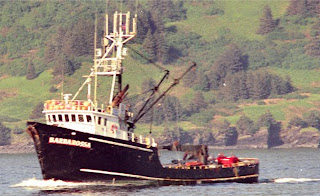
In the early morning hours of February 10, 1991, the 98 foot crabber Barbarossa disappeared near the Pribilof Islands in the Bering Sea, most likely after rolling over with a load of 80 crab pots on deck.  Six men died- skipper George Brandenburg, Dennis Olberding, Tim Schmitt, Darryl Gross, Brian McPherson, and Don Bright. Brandenburg, Olberding, and Schmitt were long time Kodiak fishermen and their loss still cuts deep in this community whose fortune is bound so tightly to the sea, and for which it has paid so dearly with the lives of its fishermen. They were good men who died young, undeserving of their fate.

But there is more to the story of the Barbarossa than its instability or the loss of six men, as tragic as those deaths were. In a strange and circumstantial reminder that nothing is certain at sea, and that fate is an invisible hunter, two crewmen got off the boat only hours before she sank, and were replaced by two unluckier men. The boat’s engineer, Dave Mathison, broke his wrist shortly before the last trip, and the cook, Rodney Horning, was put ashore on St. Paul Island after an argument with the skipper. Even more bizarrely, Rodney Horning was actually Danny Ray Horning, previously convicted of molesting his daughter and fleeing from a California murder charge to the wilds of the Bering Sea.

The story of how Horning came to be on the Barbarossa began the previous September, when an angler fishing in a river near Stockton, California hooked a trash bag containing the dismembered leg of a local catfish farmer and sometime marijuana dealer named Sammy McCullough. Police later found Mr. McCullough’s torso, severed head and arms, and the steak knife he was cut up with in the same river. He had been shot in the head with a .22 caliber rifle.

McCullough had previously been robbed of a large sum of money, presumably related to his marijuana business, and had testified against Danny Ray Horning’s brother Steven, who did time in prison for the crime. Police matched the slug found in McCullough’s forehead with a .22 caliber rifle belonging to Danny Ray, but by then he’d had skipped to parts unknown.

Five months later, a few days after the Barbarossa went down, Danny Ray Horning, still calling himself Rodney Horning, told an Anchorage reporter about his near miss on the Barbarossa. He claimed the boat was unsafe and that he’d quit after quarreling with skipper Brandenburg over a bowl of mushroom soup. Mathison the engineer would later maintain that Horning had been fired for being incompetent and lazy, and that he’d threatened to kill Brandenburg.

On March 22, 1991, six weeks after the Barbarossa rolled over, Horning was arrested in Winslow, Arizona, coming out of a bank with $25,000 of other people’s money, a hostage bank manager, and a 9mm pistol registered to the previously murdered Sammy McCullough. At trial, Horning bragged that no prison could hold him and taunted the judge to give him the maximum sentence. The judge obliged with four consecutive life sentences for robbery, kidnapping, and assault. With Horning apparently on ice for the rest of his life, California authorities declined to extradite him for the McCullough murder, a decision they would long regret.

In May 1992, Horning escaped from the Arizona state prison in Florence, and led lawmen on a 54 day chase across Arizona and New Mexico. Along the way, he burglarized houses for food, guns, and money, robbed another bank, hid out in the Grand Canyon, and carjacked a number of people, including two female British grad students in a rental car. He let them all go unharmed after cheerfully regaling them with tales of his exploits, minus the parts about child molestation and dismembered bodies.

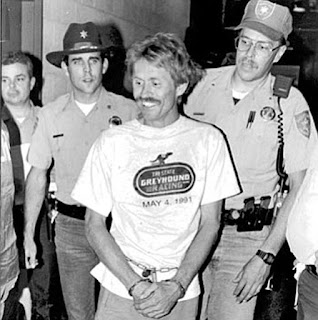
Danny Ray Horning after his capture in July 1992

When police finally caught him asleep under a porch with a 44 magnum revolver in his hands, he told his captors that “It was really a fun chase. I wish I could do this every week.”

Horning was eventually extradited to California and sentenced to death for the murder of Sammy McCullough. He has been on San Quentin’s Death Row since 1995.

Wednesday, January 26, 2022

The Wreck of the Selendang Ayu, December 2004

Flight Mechanics on Coast Guard helicopters, the people who hang out the door and run the rescue hoist, wear a gunner’s harness to keep from falling out, with a buckle that, depending on which way you put the harness on, can be released with either hand. The Coast Guard doesn’t care which way a mechanic puts the harness on, but Brian Lickfield put his on the same way for every flight for 17 years, against the day when that might matter and his hand would hit the release without thinking, and he would swim away from a sinking helicopter, and live.  

Eastern Bering Sea

In December 2004, the 738 foot freighter Selendang Ayu was carrying 66,400 tons of soybeans across the Bering Sea on a great circle route from Seattle to Xiamen, China. Commanded by a 52 year old Indian national named Kailash Singh, the ship had 26 officers and men.

On December 6, 100 miles northwest of Dutch Harbor, the ship’s engine shut down, the result of cracked rings in cylinder number three. As the ship’s engineers worked unsuccessfully to get the engine going again, the weather deteriorated, towing attempts by the Coast Guard and a commercial tug failed, and the ship drifted southeast toward Unalaska Island. By the morning of December 8, the ship was five miles from shore in a 60 knot northwest wind and 30 foot seas. The Coast Guard launched two Kodiak based H60s Jayhawks from Cold Bay to get the crew off.
Selendang Ayu drift route


Selendang Ayu aground on Unalaska Island

When the helicopters arrived, they found the sailors disorganized, panicked, and not at all sure they wanted to be hoisted into a howling winter storm off a ship that was not yet sinking. Perhaps not fully appreciating the situation, several got into the basket with their suitcases. By 3 p.m. however, with the ship now less than a mile from shore, the two H60s had each rescued nine sailors.

The first helicopter, CG number 6020, lowered its nine its sailors to the cutter Alex Haley, which was standing by a mile away. The other H60 CG number 6021 flew to a rendezvous point on Unalaska Island, transferred its passengers to the first helicopter, and flew to Cold Bay, where it was grounded with mechanical problems. The first H60 then flew Dutch Harbor, unloaded the rescued sailors, refueled, and flew back to get the ship’s eight remaining crewmembers.

In sea and wind conditions far outside the Coast Guard’s usual parameters, the Alex Haley launched its own H65 Dolphin to fly backup.

At 5 p.m., with daylight fading, the ship grounded on a reef a thousand feet from the breakers at Skan Bay.

Brian Lickfield, the Flight Mechanic on the returning H60, would later tell a reporter, “I flew for sixteen years before this happened, and that was the worst conditions I've ever seen. It was just crazy- snowing, blizzard conditions and thirty, forty foot seas.”

Co-pilot Doug Watson, sitting in the right seat, held the helicopter above the port side of the ship’s bow, but as Lickfield lowered the hoist, blue bolts of static electricity generated by the rotors arced from the basket to the ship. The terrified sailors refused to get into the basket.

The rescue swimmer, Aaron Bean, went down to straighten things out. Gesturing, cajoling, and tossing suitcases aside, Bean had just put the seventh man in the basket when, pilot Dave Neel saw a wave larger than any wave he had ever seen coming out of the darkness. He took the controls from Watson and pulled the machine up as fast as he could make it go.

A hundred feet above the ship’s deck cranes, Lickfield had just pulled the seventh sailor into the cabin when the wave struck the side of the ship, transferred its mass and energy vertically, and engulfed the helicopter in sea water. The windshield went white with sea foam and Lickfield hollered “We’ve got water in the cabin sir! Up! Up! Up!”

Alarms sounded and red lights came on and the engines spooled down with the diminishing whine of a train whistle going away. Watson pushed the nose down to fly out of the problem, but there was no power to fly anywhere. The helicopter fell.

The torque in the main rotor spun the airframe counterclockwise, slamming the tail into the side of the ship, immediately followed by the main rotor blades, which shattered on the ship’s rail. Rescue swimmer Bean and Captain Singh, the last sailor on the ship, crouched as pieces of steel ricocheted around them.

Watson’s attempt to fly had helped however, and the helicopter hit the water at somewhere between a crash and a landing.

Years later Lickfield would tell an interviewer, “You never think there’s really going to be a situation where you just crash in a helicopter… but you better hope it's really a crash because I'm leaving. Right?”

As the fuselage rolled over and the cabin filled with water, Lickfield grabbed the edge of the door, instinctively hit the release on the right side of the gunners belt he had put on the same way every time for 17 years, pulled himself though the door, and swam for the surface.

Neel and Watson swam out of the cockpit and the H65 flying backup hoisted them and Lickfield and a crewman from the ship, who came up with the hoist cable wrapped around his neck, unconscious but alive. The other six sailors were never found. The H65 flew the survivors to Dutch Harbor.

Just after 7 p.m., the Selendang Ayu split in half, with Aaron Bean and Captain Singh still standing on the bow. At 8:30 p.m. the H65 returned and hoisted them off the wreck.

On the Dutch Harbor tarmac that night, as Lickfield walked away from the H65 that had pulled him out of the water, he saw the CG number on its side, number 6513, and realized it was the same helicopter he had qualified in as a flight mechanic, in 1992. It had been rebuilt at least once, but it was the same airframe.

Selendang Ayu aground and broken in half 
at Skan Bay, Unalaska Island, December 2004

Over the next few weeks, the ship broke up, spilling its cargo of soybeans and 440,000 gallons of fuel oil into the sea, prompting an expensive cleanup operation. The ship’s surviving crew went back to India and the Philippines and China and the Coast Guard people who rescued them went back to work. The rescue remains one of the most logistically complicated operations the Coast Guard ever attempted.


Coast Guard helicopter CG 6020 on the beach
at Skan Bay, Unalaska Island, December 2004

Sources:

National Transportation Safety Board Selendang Ayu Marine Accident Brief, September 2006

Selendang Ayu Incident: After Action Review USCG MSA Anchorage 7/31/2005

Underwater Egress Handbook for U.S. Coast Guard Aviation Personnel

The Edge of Survival, 2010, by Spike Walker

Interview with Brian Lickfield, November 2021


Tuesday, November 2, 2021

“Of knots it is necessary that I speak,” - A Naval Repository, 1762

 For fisherman and sailors, the ability to tie a few useful knots is essential and among the first things a greenhorn learns. Knots can be learned from books and even YouTube videos, but most novices depend on their more experienced fellow deckhands for hands-on lessons, until their “fingers can see,” the knots and they can be tied without thinking.

Sailors tying knots, from
Ashley Book of Knots

In Kodiak, the basic knot kit includes a bowline, clove hitch, square knot, sheet bend, and a belaying knot to secure a boat to a dock. Crab fishermen also use the Carrick bend to tie buoy lines to their pots, and local longliners often use a Japanese longline knot to tie their skates together.

It is worth mentioning here that while many non-mariners and green deckhands use the words “rope,” and “line,” interchangeably, these are two different things. Rope is unutilized cordage, as for example the spooled coils of rope for sale at marine supply stores. Line is rope which has been put to a specific task, such as a mooring line.

Aside from decorative knots, of which there are many, utility knots - whether used at sea or in other endeavors – are of three varieties. A “hitch,” fastens a line to an object, a “bend,” attaches two pieces of line to each other, and a “knot,” stands alone in a piece of line. Humans have been using these to master their environment for a very long time.

The oldest evidence of knots as a technology are grooves carved around the base of stone spear points indicating that knotted plant fiber or animal sinew, long since rotted away, was used to tie the points to wood or bone weapon shafts. The oldest of such points have been found in South Africa and date to 500,000 years before the present, a place and time indicating the knots were tied by a hominid species called Homo heidelbergensis, an ancestor of ours who lived several hundred thousand years before modern Homo sapiens evolved into the world.

The first physical evidence of braided line is a wisp of three-ply cord found in a rock shelter in France, woven from the inner bark of an evergreen tree. Three strands, each twisted separately clockwise and then twisted counter-clockwise together, form the finished braid, exactly as rope is made today, though machines do this now instead of hands. Entwined around a flint blade, the assemblage is believed to have been made by Neanderthals 40,000 to 50,000 years ago.

Moving up the evolutionary tree of knot technology, a piece of mammoth ivory found in a cave in Germany in 2015 is believed to have been used by anatomically modern humans to make braided rope 40,000 years ago. Fiber strands would have been pulled through four holes drilled in the tool, and then twisted into a single plaited rope.

The oldest physical scraps of tied knots date back only about 15,000 years however, and the first recognizably modern knot, an early version of a bowline, was found on a 2,500-year-old Egyptian Pharaoh’s boat unearthed in 1954.

Knots enter the written record when John Smith, paramour of Pocahantas and a founder of Jamestown, mentions the bowline in “A Seaman’s Grammar,” in 1627: "The Boling knot is also so firmly made and fastened by the bridles into the cringles of the sails, they will break, or the sail split before it will slip."

By the middle of the 19th century, as the Age of Sail reached its zenith and thousands of inexperienced young men were going to sea, numerous volumes described knots which had previously been taught only by direct demonstration, from hunter to hunter and sailor to sailor, since the dawn of history.

Ashley’s Book of Knots, first published in 1944, is now considered the gold standard of knot tying books. Clifford Ashley, trained as an artist, became passionate about knots after drawings sailors at work on a New England whaling voyage. With economical and elegant prose and easily understood diagrams, his book describes about 3,900 knots, from the ubiquitous bowline to arcane specialty knots, decorative plaits, and even “trick knots,” useful mainly for making sport of the gullible.

Of the previously mentioned Carrick bend, Mr. Ashley says it “is perhaps the nearest thing we have in a perfect bend. It is symmetrical, it is easy to tie, it does not slip easily in wet material, it is among the strongest of knots, it cannot jam and is easily untied.”


Mr. Ashley does not exaggerate. Easy to learn and fast to tie, the Carrick bend allows crab fishermen to swiftly add or subtract pre-measured 25 fathom “shots” of line to or from the line connecting a pot to its buoy, to make the overall length appropriate to the depth into which the pot is dropped.

If made correctly the Carrick bend knot will hold so long as the line remains sound, yet can still be untied by hand, even after the knot has carried a loaded 1,000-pound crab pot to the surface a hundred times.

Interestingly, Alaskan crab fishermen have found a way to tie the Carrick bend faster and easier than shown by Mr. Ashley. A comparison between the method described in the book (see the drawing) and a demonstration by an experienced crab fisherman will prove this point.

I close with one last interesting knot, which Mr. Ashley somehow missed. Despite an otherwise encyclopedic effort he fails to mention a knot familiar to generations of seamen, perhaps even Pharaoh’s sailors, and demonstrated still for the benefit of greenhorns and children. I direct the curious to Google search for the “dragon bowline.

Sources:

The Ashley Book of Knots, Clifford W. Ashley, 1944

Science, November 16, 2012

Science Daily, April 9, 2020

Science News, July 22, 2016

Monday, March 8, 2021

Two Men and Three Centuries of Alaskan Shipwrecks

Warren Good arrived in Kodiak in 1972 and like a lot of other young men in those years, went crab fishing. Kodiak was booming, deckhand jobs were easy to get, and fishing was grueling but fun, if you liked hard work. And the money was good— it was not unheard of for 21-year-old deckhands with a scant year of nautical experience to make $100,000 in a single four-month king crab season. The dark side of the high times was the casualties.

In the years before the Commercial Fishing Industry Vessel Safety Act of 1988 commercial fishing was far and away the most dangerous job in America, and the deaths of Alaskan commercial fishermen drove that statistic. 

Sometimes the accidents were the result of simple bad luck, but often they were the predictable product of inherently dangerous work, lax safety regulations, and enthusiastic but inexperienced fishermen making poor decisions. Catastrophic mechanical failures, fires, breached hulls, groundings, capsizings, men swept overboard, and ferocious winter sea conditions were common, and these often occurred in “cascading event,” scenarios, where several bad things happened at the same time. Too often, with the small leeway for human error in such circumstances, people died.

Warren Good off Kodiak Island, 1970s. 


Warren Good reveled in the money, the work, and the high adventure, but in the early 1980s, as he watched people and boats he knew disappear, he wondered if anyone was recording the particulars of these events in a systematic and publicly accessible way. The Coast Guard and insurance companies kept their own lists of losses for their own proprietary reasons, but as far as Good knew, no one else was tracking  the names of the lost boats and their dead crewmembers except for friends and families.

At the same time, no one seemed to recognize Alaska’s commercial fisheries as part of the larger fabric of Alaskan and therefore, American history. Perhaps that was because the fishing boom and the losses that went with it were happening in the present and people were too busy living it, but Good wondered if anyone had ever tried to list all the other marine disasters that had happened in Alaska before the 1970 during the World Wars, the Gold Rush, the whaling days, all the way back to the 18th century Russian fur hunting era.

With the vague notion that if a comprehensive list of Alaskan shipwrecks didn’t exist it was something the world needed, he began researching in Kodiak’s A. Holmes Johnson Library between fishing seasons. There he found an Alaska Packers Association list of Alaskan marine accidents on microfiche, donated by a Washington state historical society and apparently sent to every library in Alaska. The APA list was itself culled from an old Customs Service publication. Good cross referenced the names and dates on that list against citations in books and newspaper articles and began keeping a file. He took photos too of the boats and fishermen on Kodiak’s waterfront in that present moment of the 1970s and 80s, knowing they would not all be afloat or alive in some near and uncertain future.

At some point he realized he was on a mission to document all the vessels which had ever untied from an Alaskan dock and never come back. As far as he knew he was alone on his own crusade.

But Good was not alone. A Federal employee named Mike Burwell was doing the same work in Anchorage as part of his job with the U.S. Mineral Management Service (MMS), a division of the Department of the Interior.

Mike Burwell in Kodiak 2011

In the mid-70s MMS was planning to lease millions of acres of underwater real estate in the Gulf of Alaska and the Bering Sea to oil companies. Being a Federal agency, MMS was required by Section 106 of the National Historic Preservation Act “…to take into account the effects of their undertakings on historic properties.” As a first step in that direction an MMS employee named Everett Tomfelt wrote a technical paper listing a few known Alaska shipwrecks. Burwell, an MMS technical writer, was asked to edit the paper but soon was passionately researching and expanding the list himself. He began with the same Customs Service shipwreck list that Warren Good was working on in Kodiak.

In 1992 MMS published Tomfelt and Burwell’s shipwreck list. The list was mentioned in an Anchorage Times article but except for a few Alaska historians it remained virtually unknown to anyone outside MMS and the oil industry.

For two decades Good and Burwell researched and catalogued many of the same shipwrecks from the same sources, including books, newspaper stories, Coast Guard reports, and court documents from lawsuits against insurance companies. Until computers and the internet arrived in the mid-90s, everything was on paper or microfiche. Burwell catalogued his list temporally, by year, month and day, while Good catalogued his alphabetically, by ship names.

At some point in the early 2000s they became aware of the other’s work but continued to work independently until Burwell uploaded his database onto the MMS website and retired to Arizona in 2011. By then his list had grown to a 600 page table of shipwrecks from 1729 to 2000. That same year Good, who had stopped fishing in the 1990s and moved to Florida, put his own database online as the Alaska Shipwreck website.

The MMS/BOEM database has not been updated since Burwell left the agency in 2011, but since then, he and Good have worked together to update the Alaska Shipwreck website archive. It now includes thousands of documents, articles, photographs, Coast Guard records, obituaries, and marine charts. Good also has a modest collection of physical artifacts and ephemera including crew share contracts and pay stubs, old Kodiak bar and restaurant menus, photographs, slides and film negatives, and hundreds of 19th and 20th century books and magazines.

The two men continue to research independently, Burwell compiling his findings by date and Good alphabetically, but the combined database is now searchable by both year and ship name. Burwell sends Good his findings, which Good “scrubs,” to crosscheck information he may already have, and then he uploads the data to the Alaska Shipwreck website. The website itself generates hundreds of inquiries every year from other researchers and relatives of lost mariners. Good answers all of these, often with arcane details not listed on the website. The cost of doing the research is not inconsiderable, including hardware and printing costs, newspaper subscription fees, and for Good, website expenses.

While paper records have their own preservation issues with floods and fires, Burwell’s hard drives have failed, Good’s have been hacked and destroyed by lightning. They keep each other’s files backed up, which has saved the day, but the threat of future mishaps is never far from their minds.

Lately, mortality being what it is, they’ve also started wondering what happens when they can no longer do the research themselves. Both men are in their 70s and their “somewhere down the road,” plan options include handing the database and files over to some Alaskan state agency which can safeguard it and continue the research, though no one in the state bureaucracy has expressed much interest in this scenario. Another possibility is for a private institution to take over the project, but so far, this idea has also not elicited any takers with the necessary resources.

The Alaska Shipwrecks database can be found here: www.alaskashipwreck.com.

Thursday, February 18, 2021

100 Years of Counting Fish at the Karluk Weir


Counting salmon at Karluk Weir,  Sept. 1948
The first salmon counting weir in Alaska was constructed on the Karluk River in 1921, and every summer since then the weir has provided a remarkable stream of information which has been vital to understanding salmon and successfully managing them.
The original Karluk weir was a series of wooden tripods set across the river with planks laid horizontally between them on the upriver side. Spaced a few inches apart, the planks allowed water to flow downstream but prevented fish from swimming upstream. A narrow open section allowed biologists to count salmon as they swam through.
For much of its length the Karluk River is about a hundred yards wide and three feet deep, a modest stream compared to other great salmon rivers. But Karluk Lake, where the river’s sockeye lay their eggs, is an overachiever, and its huge numbers of returning spawners drew the early attention of the commercial canning industry.
The first cannery at Karluk put fifty-eight thousand red salmon into cans in 1882, and by 1901 four million Karluk sockeye salmon were processed, a number which has never been equaled.
The fish were caught with hand hauled beach seines, a crude technology by today’s standards. But the nets were pulled across the opening to Karluk Lagoon relentlessly, one behind the other like the spokes of a giant paddle wheel, 24 hours a day, seven days a week, and they were deadly effective. Single haul catches of 30,000 fish were not unheard of, and a single haul in 1896 took 75,000 fish.
This kind of unbridled resource extraction was common in the 19th century, and even celebrated, from salmon and buffalo to whales and dodo birds. Most people then believed God would keep putting fish and whales in the water no matter how many were taken by humans. As British biologist Thomas Henry Huxley put it in 1833, “I believe then, that the cod fishery, the herring fishery, the pilchard fishery, the mackerel fishery, and probably all the great sea fisheries, are inexhaustible… and any attempt to regulate these fisheries seems consequently, from the nature of the case, to be useless.”
But as salmon runs in Alaska and the Pacific Northwest declined, it began to dawn on biologists, and even some canners, that the more salmon they took the fewer seemed to return in following years, and that some minimum number had to get upstream for a run to continue. 
With this vague notion in mind the Federal government began instituting various restrictions and even the canners themselves decided to close the Karluk fishery a few hours a week in the 1890s. Still, by the 1920s, Karluk sockeye catches had fallen to fewer than a million fish a year- still substantial, but far below the record 1901 season.
At the time no one knew how many spawners it took to sustain a particular run, or even how many salmon actually went up the Karluk or any other Alaskan river. It was also not fully accepted that salmon migrate quite specifically back to the streams where they had spawned.
In this information vacuum, Federal salmon managers were pulled between conservation minded biologists with unverified hunches and processors who wanted to can more fish. Since Congress wrote Alaska’s fishing regulations and the processors had the political power to bend Congress to their point of view, regulations remained weak and salmon runs kept declining.
In 1918 however, a Russian fisheries professor named Fedor Baranov wrote a formula which calculated future fish catches as a function of initial fish population and pressure on that population from natural mortality and past human fish catches. This revolutionized fisheries management theory but came with a catch- it required knowing how many fish there were to begin with. But since fish usually swim where they cannot be easily seen or counted, this was not a simple thing to determine.
Fish populations can be estimated by tallying catches and doing surveys with hooks or trawls or pots or today, sonar. But catches and surveys provide only a statistical estimate of how many fish there were before the catching started, and if this initial population of fish is overestimated, or the estimated percentage of that population which can be sustainably caught is too high, they can be overharvested, leading to a population crash. If you’ve lived in Kodiak long enough you’ve seen several once abundant fisheries managed this way go bust, including shrimp and king crab.
But salmon, unlike almost all other marine fishes except for eels, migrate up rivers, and when channeled through weirs can be counted with great accuracy. This allows Baranov’s formula to be successfully applied, and the weir counts on the Karluk allowed salmon biologists to do just that.
Once they knew how many fish swam up the Karluk in any given year, biologists could add the number caught by fishermen and then compare that total number to the number of fish returning in following years. This gave them a very good idea of how many spawners it took to produce a given number of returning fish, and therefore how many fish had to escape past fishermen to maintain a long-term run. And because salmon can be counted every day as they pass through the weir, fish managers could track daily fish counts against the historic data to sustainably manage the fishery day by day.
Hundreds of weirs were eventually installed in rivers all over the state and since 1959, when ADF&G managers began using weir data to manage salmon, that system has proved remarkably successful, first to rebuild Alaska’s salmon runs, and then to maintain them.
Weirs make it relatively easy to manage fishermen and overfishing has been regulated out of existence in most areas of the world where salmon historically returned in great numbers, including Alaska. However, the incremental destruction of spawning habitat with dams, roads, parking lots, houses and irrigation systems is exquisitely hard to manage and is now the main threat to remnant salmon populations in Northern Europe, Japan, New England, and the Pacific Northwest.
Indeed, as Alaska’s urban population grows, this may be happening now in the Mat-Su Valley. Even as commercial fishing in Cook Inlet is constrained, growing suburban sprawl, plus predation by invasive pike introduced by humans, may be driving the decline of salmon numbers there.
Weirs helped Alaskans keep our salmon runs strong for a long time, and in places where the human footprint on spawning lands is slight, they will continue to be useful in controlling fishing effort. In the coming centuries however, as humans take more and more land away from salmon in Alaska, and as chemicals from our global civilization drain into the ocean salmon swim in, how we keep salmon runs alive in Alaska remains to be seen. 

This article first appeared in the Kodiak Daily Mirror January 13, 2021

 Key Sources:

Gard, Richard, and Richard Lee Bottorf, A History of Sockeye Salmon Research, Karluk River System, Alaska, 1880-2010, U.S. Department of Commerce, 2014

Orth, Don, The Overfishing Problem,

https://vtichthyology.blogspot.com/2019/09/the-overfishing-problem-by-don-orth.html


Roppel, Patricia, Salmon From Kodiak, Alaska Historical Commission, 1986

Fedor Baranov  https://en.wikipedia.org/wiki/Fedor_Baranov#The_catch_equation 

Wednesday, May 13, 2020

Disease Comes by Sea

Orphans at Nushagak, Alaska 1919
Photo: Alaska State Library

In the long sad history of contagious diseases in Alaska, at least since written records have been kept and until the invention of airplanes, all have come by sea.
European contagions first arrived in the Americas with Columbus, and for the next four centuries, sailors and passengers regularly delivered diseases to a population of First Americans who had little immunity to them.  The result was a seaborne genocidal disaster which killed millions, and from which indigenous American cultures have never fully recovered.
Europeans and their ships did not arrive in Alaska until the mid-1700s, but the local inhabitants were no better at surviving the new viruses and bacteria than their southerly cousins.
The first recorded Alaskan epidemic was a respiratory ailment brought to the Aleutians by a Russian ship in 1791 and subsequently spread to Kodiak Island. In 1802 a fever came to Atka on the Russian ship Alexander Nevsky. Influenza ravaged Kodiak in 1804 when the Boston ship O’Cain arrived from California with a crew of returning Alutiiq sea otter hunters. Well into the 20th century epidemics continued to sweep Alaska with depressing frequency — influenza, smallpox, measles, tuberculosis, and various unclassified fevers and coughs — all carried on ocean crossing ships.
An influenza outbreak in 1819 is particularly well documented. It first killed about fifty people in Sitka after its arrival from Java on an American merchant ship. In November it sailed from Sitka to Kodiak on the Russian American Company vessel Finlandia.
Within a few days of the Finlandia’s arrival, nearly everyone in Kodiak was afflicted, from babies to elders, and a few days after that, forty-eight people were dead, a third of the local population. The symptoms, speed, and lethality of the disease have led modern epidemiologists to believe it was a strain of the influenza virus which has afflicted humans for millennia, and of which Covid-19 is only the latest variety. 
Seymon Yanovsky, the 31-year-old Russian American Company manager for Alaska, was in Kodiak with his wife and infant son at the time. He wrote later that the illness began with “a fever and a heavy cold, a cough, shortness of breath, choking, and three days later death followed!”
Yanovsky described the scene in a “kashim,” a large wooden communal structure, where more than a hundred Alutiiq people suffered through the disease:
“Some were already dying, their bodies growing cold, next to those who were still alive; others were already dead: groans and screams tore at my heart. I saw mothers already dead on whose cold breasts hungry children crawled, crying and trying to find food for themselves, but in vain.”
At the height of the epidemic there were not enough able-bodied people to bury the dead, and corpses lay above ground until the survivors rose from their sickbeds to do the digging. According to Yanovsky, “It was good the weather was frosty because there was no smell.”
Yanovsky nursed the sick with cammomile tea and warm food, accompanied by the Russian Orthodox monk Father Herman. The future saint was in his mid-60s at the time but remained healthy, and according to Yanovsky, “ceaselessly, tirelessly, and at great personal risk, visited the sick, not sparing himself in his role as priest- counseling those suffering to be patient, pray, repent, and prepare themselves for death.”
Yanovsky and his family got the flu and prepared their own selves for death, but after a few days recovered and returned to Sitka. Father Herman went back to Spruce Island and built an orphanage there for the children whose parents had not survived.  
While the influenza epidemic of 1819 is forgotten in Sitka and Kodiak, its return in 1918 and 1919 remains a shattering cultural memory in western Alaska.
The virus arrived in Nome in the fall of 1918 on the steamship Victoria from Seattle. Before it burned through the available human kindling in mid-winter, it killed hundreds of people in villages on the Seward Peninsula. The following spring it came to Bristol Bay.
No one knows what ship brought the virus— historians argue over a boat from Unalaska with an infected priest or a cannery supply ship from Seattle. Regardless of its origins, by July the flu had killed an estimated 40% of the adults in Bristol Bay, orphaned hundreds of children, and destroyed the social fabric of dozens of communities.   
With 1919 still very present in their minds, the people of Dillingham recently asked the Governor to shut down this summer’s Bristol Bay salmon fishery to prevent the arrival of Covid-19 carrying fishermen and processing workers. Given the current low profile of the virus in the state however, not to mention the economic weight of the fishery, the State has decided instead to proceed with the fishery using protocols and mandates to maintain a Covid-free salmon season.
Viruses defy prediction however, and whether those edicts will prevent an outbreak is this summer’s multi-million-dollar question. A few cases in Egegik in the next few weeks could change the current calculus of risk and reward, of mortality versus money. For now, just days away from the state’s first salmon opening of the year, in Cordova, the only certainty is that humans have yet to outrun viruses and the power they wield on individual lives and global history remains undiminished.

Sources:
Chills and Fever: Health and Disease in Early Alaska, Robert Fortuine, 1989
An Epidemic, A Governor, and a Saint (1819), Alaska Medicine, Fall 1990
Alaska Packers Association Report on the 1919 Influenza Epidemic
Influenza in Bristol Bay 1919, Maria Gilson de Valpine, Sage Journal, Spring 2015

Monday, March 16, 2020

The Fate of the Marten at Spruce Cape

The Marten. Photo: Michelle Fisk
The Marten was an 82-foot wooden power scow rigged for crab, a twin shafted boat with a white wheelhouse on the stern of a white hull. A Kodiak fisherman named Jim Fisk had owned and skippered her for years, but in February 1975 he had Jeff Alexander, 21, running the boat with three men on deck- Jim Rich, Mike Rowe, and Deere Alioski. 
After working near Sand Point for several weeks, the boat tied up in Kodiak around four in the afternoon of Thursday, February 20. Around 9:30 p.m. they untied and headed to the Wakefield processing plant in Port Lions, thirty-five miles away.
The Marten's planned route to Port Lions,
according to the Coast Guard.
Courtesy Don Bodron
A 40-knot northeast wind loaded with snow met them as they came out of the channel, passed Jackson’s trailer court and the red Number 10 channel buoy, and aimed for buoy Number 8, a flashing red light moored just east of Channel Rock, 500 yards from the cliffs on Spruce Cape Road. The snow obscured the light however, and the Marten’s radar was suddenly useless too, as snowflakes smothered the scanner. Alexander backed off on the throttle and idled ahead, trying to get his bearings.  
The smell of smoke suddenly diverted the crew’s attention but was determined to be engine exhaust blown back into the wheelhouse by the wind.
Just as Alexander returned to looking for the Number 8 light, the hull bumped hard against something solid and a mass of white water came out of the darkness, a wave breaking over shallow rock. The light they intended to pass on their port side was now somewhere off to starboard, and the rock that should have been even farther away to port was now under the boat. Twenty-foot seas repeatedly dropped the boat on the rock and the hull planks began splintering.
At 10:00 p.m., Alexander called the Coast Guard on the single sideband radio, but the Coast Guard did not hear him. The transmission was picked up instead by a local pilot named Herb Downing from his house near Mill Bay. Downing phoned the Coast Guard and by 10:30 a helicopter was in the air. The 84-foot steel vessel Theresa Marie also heard the call and left the harbor to come to the Marten’s aid
Alexander told Downing they were “off Spruce Cape near the red buoy… in the channel,” meaning the red buoy off Channel Rock. The Coast Guard and the Theresa Marie misunderstood this however, and headed for the Number 4 red swing buoy, a mile and half beyond Channel Rock, off the tip of Spruce Cape. Then Marten’s engine room flooded and the lights and radio died. The boat was invisible in the snowy darkness, and the helo flew past it.
Coast Guard search area and actual wreck site.
Courtesy Don Bodron
 In 1975 survival suits were common but not required, and there were none on the Marten. The crew donned their life jackets. They deployed the life raft off the wheelhouse roof, but it swamped in the breaking surf, and the weight of the water in it prevented the men from pulling it back to the boat against the wind and waves.  
The seas banged the boat across the rock and then rolled it upside down off the rock’s  shoreward side. The fishermen clung to the propeller shafts for forty-five minutes and then, one by one, were swept away.
Alexander and one crewman swam 500 yards to shore, but the crewman died in the surf. Alexander climbed the rock face almost to the top before seizing up. He watched the lights of the Coast Guard helicopter and the Theresa Marie searching out near the swing buoy, until the helo ran out of fuel and went back to the Air Station.
The capsized hull of the Marten at Spruce Cape
February 21, 1975. Photo: Don Bodron
At 2:30 a.m. a policeman found Alexander on the cliff, hypothermic but conscious. The bodies of the three crewmen were recovered along the shoreline the next day.
Alexander told the Coast Guard investigator they were headed for Port Lions to deliver 500 king crabs which they’d picked up from storage on the way into town that day, presumably from crab pots with the tunnels tied shut. He cited the urgency of getting another of Fisk’s boats ready for fishing as the reason for leaving that night, rather than waiting for the storm to subside.
Closeup of the Marten at Spruce Cape, February 21, 1975.
Photo: Don Bodron
Alexander did not mention that King Crab season had been closed for weeks by then, or that fear of being caught with illegal crab in Kodiak might have influenced the decision to make for Port Lions, where enforcement was less likely.
Jim Fisk was in Anchorage that night, and presumably reachable by phone, but whether he talked with Alexander before the boat left for Port Lions, or how much he knew about the boat’s activities before it arrived in Kodiak, is unknown. He died in a car wreck in 1995.
Kodiak Daily Mirror, February 21, 1975.
              KMM archives. 
Jeff Alexander hung around Kodiak for a year or so and then disappeared. In 2006 a Seattle reporter talked to him while doing a story on homeless people. He was on methadone, living in his truck and panhandling in Ballard. He’d done time in prison for drugs and assault and theft, but he showed the reporter a garden he’d built near the bridge. The orderly rows of kale and flowers seemed a minor miracle in an otherwise desperate story of trauma and addiction.
Later that summer, Alexander was jailed for failing to appear on a couple of traffic citations and a theft charge. In September 2006 he fell out of a bunk in the King County jail, broke his neck, and died.
It is impossible and unfair to conjecture on what Alexander’s life might have been had the Marten stayed tied to the dock that February night, or if the other men on the boat had survived. Alexander’s family and friends remembered him as intelligent and kind, a talented young man who could have done anything with his life. But knowing what we know now about the costs of trauma, it is not hard to imagine a trail of cause and effect from that night on Spruce Cape to heroin and panhandling at the foot of the Ballard Bridge. And for sure, not every sea story ends when the wind calms and the sun comes up the next day.

Sources:

Kodiak Daily Mirror, February 21, 1975.
“Report on the Marten.” Don Bodron, former U.S. Coast Guard Investigator
“Blossoms of Hope Wilt Away.” Danny Westneath, Seattle Times, September 24, 2006